Thursday, November 9, 2023

General questions.

How do you distinguish between commercial farming and subsistence farming on a 1:50 000 topographic map?

Commercial farming

Subsistence farming

·        The farm will usually have a name.

·        Farm road to farm buildings connecting with formal roads (e.g. secondary road)

·        Many farm buildings

·        Advance farming features such as dams, canals, windpumps, silos.

·        Large cultivated lands (use of tractors)

·        Cultivated lands have geometric shapes (tractors can plow in straight lines)

·        No names

·        No or few “other roads” not connected to formal roads.

·        No farm buildings, only huts

·        No advanced farming features such as dams, canals, windpumps (don’t have the capital or technology to build these).

·        Small cultivated lands and fragmented.

·        Irregular shaped cultivated lands due to the use of basic ploughing methods.


Friday, July 18, 2014

Heights and contour lines

Heights can be indicated in FOUR ways on a topographic map.

1.     Contour lines - lines (brown) joining areas with the same height above sea level. The contour interval (difference between contour lines) on a 1:50 000 topographic map is 20m.
2.     Spot heights - indicated by a black dot and height value (absolute height in meters above sea level) of a specific point on a topographic map.
3.     Trig. beacons (triangulation station or trigonometrical point) - indicated by a triangle which shows its unique number and height above sea level up to one decimal of a meter.

A Trig. beacon

4.     Bench marks - indicated by an arrow pointing to a main road with the height in meters above sea level.


Aerial Photographs

Aerial photographs are photos taken from light airplanes. These photos contain more detail e.g. orthophoto maps. Because it shows more detail the scale will be a large scale in comparison to a topographic map with less detail (small scale).

Three kinds of aerial photographs can be found –
  • Vertical photographs
  • Horizontal photographs
  • Oblique photographs


Tuesday, June 12, 2012

Mapwork in the exam

By working through previous IEB examination papers, it becomes evident that certain questions consistently appear in the Mapwork section. The examinations make use of 1:50 000 topographic maps, which are produced using the Gauss Conformal Projection. The central meridian used for the projection is also indicated on the topographic map.

Distance, gradient, and time calculations are regularly assessed, and candidates should expect to encounter magnetic bearing calculations. It is essential to understand how altitude is represented on a topographic map through contour lines (with a contour interval of 20 m), spot heights, trigonometrical beacons, and benchmarks. This knowledge is necessary for calculating gradients, identifying the highest points on a map, and describing the general relief and elevation of an area.

The orthophoto map has a scale that is five times larger than that of the topographic map. A scale of 1:10 000 is regarded as a large scale, while a scale of 1:50 000 is considered a small scale.

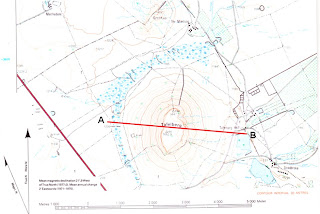
Formal cross-sections are seldom examined, as they are time-consuming to construct. However, sketch cross-sections are frequently required. A sketch cross-section is a freehand representation of the landscape as it appears on a photograph and should not be drawn as a precise graph.

Settlement-related questions are common and often focus on the types of rural settlements, such as isolated and nucleated settlements, as well as farming activities, including intensive and extensive farming. Learners should also be able to identify and explain the location of various land-use zones, including the Central Business District (CBD), the rural–urban fringe, and industrial areas.

In the Geographic Information Systems (GIS) section, learners are often required to suggest appropriate themes or layers that could be used in a presentation about a specific area. A thorough understanding of GIS concepts and terminology is therefore essential for success.

Wednesday, November 2, 2011

Street Patterns

Street Patterns in Urban Areas

Street patterns are an important feature of urban areas and play a significant role in determining how efficiently people and vehicles move within a city. Well-designed street patterns can facilitate transportation and improve accessibility, whereas poorly designed layouts may contribute to traffic congestion and make navigation more difficult.

There are three main types of street patterns:

  • Grid Iron Pattern
  • Planned Irregular Pattern
  • Cobweb Pattern

1. Grid Iron Pattern

The grid iron pattern is commonly found in the oldest parts of a city, particularly the Central Business District (CBD). It is characterized by rectangular blocks and streets that intersect at right angles.

Advantages:

  • Easy to navigate and locate destinations.
  • Streets can be extended with relative ease.
  • Land can be subdivided efficiently, making construction straightforward.

Disadvantages:

  • Numerous intersections may result in traffic congestion.
  • The layout can appear monotonous and repetitive.
  • In areas with uneven terrain, roads may become long and steep.

2. Planned Irregular Pattern

The planned irregular pattern is typically found in newer suburbs and in areas with steep slopes or challenging topography. Streets follow the natural contours of the landscape rather than a rigid geometric design.

Advantages:

  • Creates a more attractive and varied urban environment.
  • Roads are better suited to the natural landscape and terrain.

Disadvantages:

  • Streets are more difficult to extend.
  • Navigation can be challenging, and it is easier for people to become disoriented.
  • Hidden entrances and winding roads may increase safety risks.

3. Cobweb Pattern

In the cobweb pattern, streets radiate outward from a central point. This central feature may be a square, lake, dam, park, or another important landmark. Secondary roads often connect the radial routes, creating a web-like pattern.

Advantages:

  • Provides efficient access to and from the central area.
  • Creates a distinctive and attractive urban layout.

Disadvantages:

  • Traffic congestion may develop near the central point.
  • Expansion and planning can become complex as the city grows.

Understanding the characteristics, advantages, and disadvantages of different street patterns is essential for the study of urban geography and city planning.


Tuesday, May 24, 2011

Where on earth are you?

A geographic coordinate system is a coordinate system that enables every location on the Earth to be specified by a set of numbers. The numbers represent the exact latitude and longitudinal position. If you look at a Gps every object will have a specific position where a latitude and a longitude intersect,

Doesn’t matter where on the earth you find yourself, you will have a latitude and longitudinal position. In South Africa your latitude position will always be south (South Africa is positioned between 22˚ & 35˚ South and 16˚& 33˚ East). Your latitude reference will always be South and longitude reference East. E.g. 27˚38’27’’ S and 30˚18’49’’E.

How do I determine my coordinates on a topographic map?
 
As mentioned before you always give the latitude first and then the longitude.
Step 1: Identify the the object on the topographic map
As mentioned before you always give the latitude first and then the longitude.


Step 1: Identify the object on the topographic map

Step 2: Look at the top of the map and find the latitude (23˚S) and the longitude (33˚E).

Step 3: Find the minutes by looking at the latitude and longitude immediately above (17’) and to the left (25’) of the object. Your coordinate thus far is 23˚17’S and 33˚25’E

You are not yet done, as you need to calculate the seconds.

Step 4: In the grid block where your object is situated measure the following (see diagram)


Latitude: a ÷ A = answer x 60 = C

Longitude: b ÷ B = answer x 60 = D

Therefore, coordinate for spot is –

23˚17’C”South and 33˚25’D”East


Latitude: a ÷ A = answer x 60 = C''


Longitude: b ÷ B = answer x 60 = D''

Therefore, coordinate for spot is –

23˚17’C”South and 33˚25’D”East

Tuesday, August 3, 2010

Map code

How to find the map code
To be able to find the map code of a particular map it is important to understand what the map code represents
E.g.2627 CC SKANDINAWIËDRIF
26 represent the first latitude
27 represent the first longitude

The grid block formed by the latitude and longitude above is divided into 4 blocks of equal size represented by A, B, C and D
The first letter represents one of the four ‘big’ blocks, in this case block C
The second letter represents the third block within big block C which is divided into four smaller blocks A, B, C and D


South Africa is divided into a series of grid blocks consisting out of latitudes and longitudes as can see on the map below (Map 1).


To find Skandinawiëdrif on the map you need to locate the intersection between the latitude 26˚ and the longitude 27˚. Now divide the grid block into four blocks, find block C which in turns is divided into four smaller blocks. Now find small block C. There you go, you have located Skandinawiëdrif by using its map code.

Friday, July 30, 2010

Topographic map interpretation

A. Geomorphology
1. Steep gradient
2. Gentle gradient
3. Convex slope
4. Concave slope
5. Conical hill
6. Butte
7. Mesa
8. Dip slope
9. Scarp slope
10. Homoclinal ridge
11. Valley
12. Spur
13. Poort
14. Cliff
15. Saddle/ col
16. Waterfall
17. River channel characteristics
18. Braided stream
19. Drainage patterns
20. Superimposed drainage
21. Slope elements
B. Settlements and Economic activities
1. Types of towns
1.1. Mining town
1.2. Central place town
1.3. Tourist town
2. Rural settlements patterns
2.1. Isolated
2.2. Nucleated
3. Farming methods
3.1. Commercial
3.2. Subsistence
4. Farming techniques
4.1. Intensive
4.2. Extensive
4.3. Fruit
5. Land use zones
5.1. CBD
5.2. Industrial
5.3. Residential – high/ low income
5.4. Rural-urban fringe
6. Informal settlements
7. Tourist destinations
8. Choice of site
C. Environmental issues and Climatology
1. North/south facing slopes
2. Valley inversion / pollution dome
3. Anabatic/ katabatic winds
4. Erosion
5. Droughts / seasonal rainfall
6. Type of rainfall
A. Geomorphology
1. Steep gradient
· Steeper terrain will have closely spaced contour lines.
2. Gentle gradient
Flatter areas will have more widely spread contour lines.
A uniform slope is a slope with evenly spaced contours, it can be for hills of any gradient, weather it is steep or gradual, but they have to be evenly spaced.

3. Convex slope
· Contour lines close together at foot of hill
· Contour lines far apart near the crest (top)

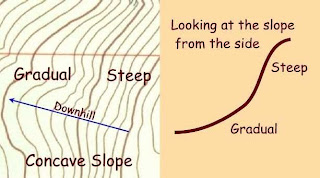
4. Concave slope

· Contour lines close together at top of hill
· Contour lines far apart near the foot of the hill

5. Conical hill
· Circular shape contour lines
· Small crest
6. Butte
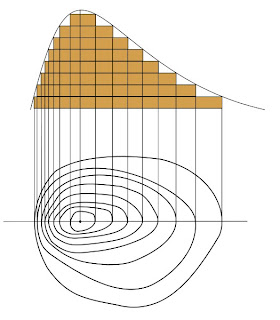
· Small flat top
· Height is 2x greater than width
7. Mesa (table mountain)
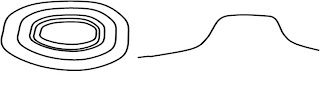
· Large flat top
· 2x wider than the height
· Resistant rock layer at top – dolerite/ granite
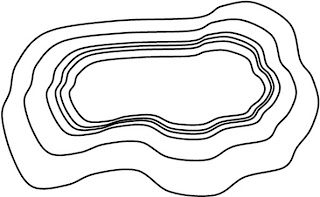
8. Dip slope and 9. Scarp slope
• Dip slope = gentle slope of mountain
• Scarp slope = steep slope of mountain
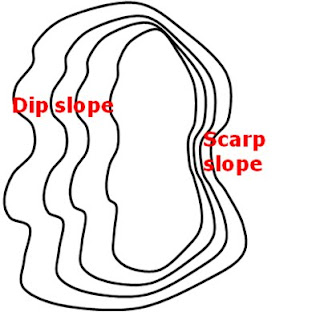
10. Homoclinal ridge
· A mountain with a clear dip and scarp slope
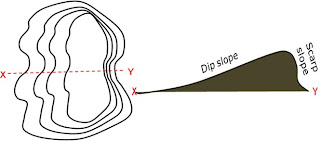
11. Valley and 12. Spur
• Valley = contour lines bend (V) towards the top of mountain
• Usually a non-perennial stream flowing down
• Spur = contour lines bend towards the foot of mountain
• Flank on both sides of a valley
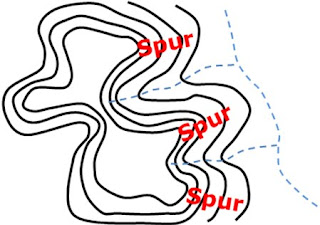
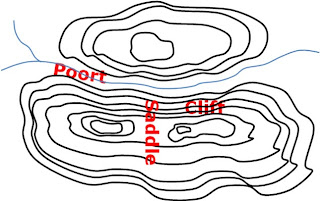
13. Poort; 14. Cliff; 15. Saddle (col)
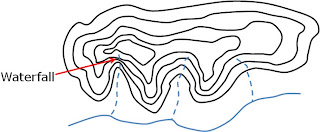
16. Waterfall

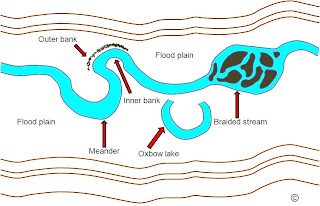
17. Stream channel characteristics
· Turbulent flow – in upper course / steep gradient / in a valley
· Laminar flow – lower course / flat gradient
· Upper course – in valley / steep gradient / straight channel
· Lower course – large meanders / oxbow lakes / large, wide floodplain / braided streams
· Outer bank – faster flowing water / more erosion / under cutting (also undercut bluff)
· Inner bank – slower flowing water / more deposition (also slip-off slope)

18. Braided stream
· Stream in lower course
· Carries large amount of stream load and sediments
· Deposition occurs due to decrease in slope and stream volume
· Deposition obstructs own flow
· Stream break up in smaller channels to flow round obstructions / sand banks or islands
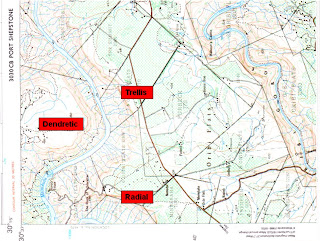
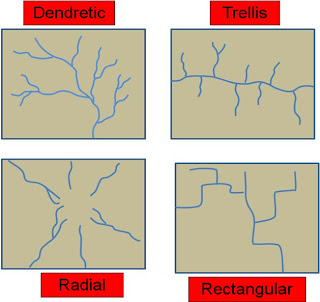
19. Drainage patterns


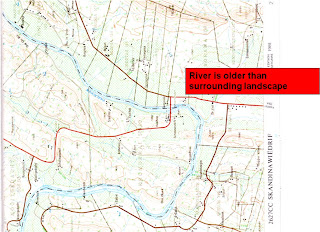
20. Superimposed drainage
The course of the river is unrelated to the present underlying geological structure
The river exposed an older underlying land structure

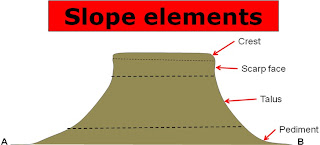
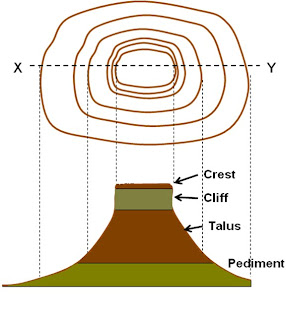
21. Slope elements


B. Settlements and Economic activities
1. Types of towns
· Mining towns: Town developed because of mining activities e.g. Postmasburg, Kuruman, Hotazel, Venterspos
· Central place towns: Small towns delivering services to surrounding farming community
· Tourism towns: Mostly small towns along the coast, towns where you find warm underground water

2. Rural settlements patterns
· Isolated/ dispersed settlements – farmsteads far apart / mostly in dry regions with low carrying capacity
· Nucleated settlements – farmsteads close together / small farms in wet regions with high carrying capacity

3. Farming methods
· Commercial farming – farm to produce a surplus to sell to a market / farms with names, roads, windmills, dams, canals / fire breaks / silos and mills / cut lines
· Subsistence farming – farm to produce only enough for own use / no roads, name, dams, small fragmented cultivated lands/ fields have few straight boundaries / numerous footpaths / huts

4. Farming techniques
· Extensive – large farms in dry regions / low carrying capacity
· Intensive – small farms in wet regions / high carrying capacity

5. Land use zones
· CBD – where main roads converge / oldest part of town with monuments / grid street pattern
· Industrial – large buildings / outskirts of town / railway lines
· Residential – oldest and lower income have grid street pattern / newer, higher income have irregular street pattern, steep slopes, view over golf course or natural environment
· Greenbelts – areas where natural environment is kept and preserved / no development allowed / e.g. river floodplains; hills and mountains
· Recreation (Rec) – areas used for recreational purposes / e.g. sport grounds; park
· Rural urban fringe – areas surrounding build up areas (town) / here we find mixture of urban and rural functions / e.g. graveyards; golf course; sewerage works; brickworks; agricultural holdings; aerodrome; etc.


C. Environmental issues and Climatology
1. Aspect
  •  North facing slopes – receives direct sunlight / warm
  •  South facing slopes – in the mountain shadow / cooler

2. Valley climates
Valley breezes – anabatic wind blows during the day, up slope / katabtic wind blows at night, down slope / cold temperatures (frost pocket forms in bottom of valley

4. Pollution – industries situated in bottom of valleys / pollution trapped

5. Erosion
· Occurs along steeper slopes
· Little vegetation increase rate of erosion
· Wind breakers (trees planted in straight rows adjacent to cultivated lands) slow speed of wind down / less erosion during the dry season

6. Droughts & seasonal rainfall
· Seasonal rainfall can be identified if a topographic maps shows a lot of –
  • Non-perennial streams
  • Windmills
  • Reservoirs
  • Dams
  • Canals
· Above features indicate the need to store water for dry season

7. Types of rain
· Convectional rain – over interior of South Africa
· Relief / orographic rain – mountain areas
· Cyclonic rain – along the SW Cape and Southern Cape